Meme coin entry strategy
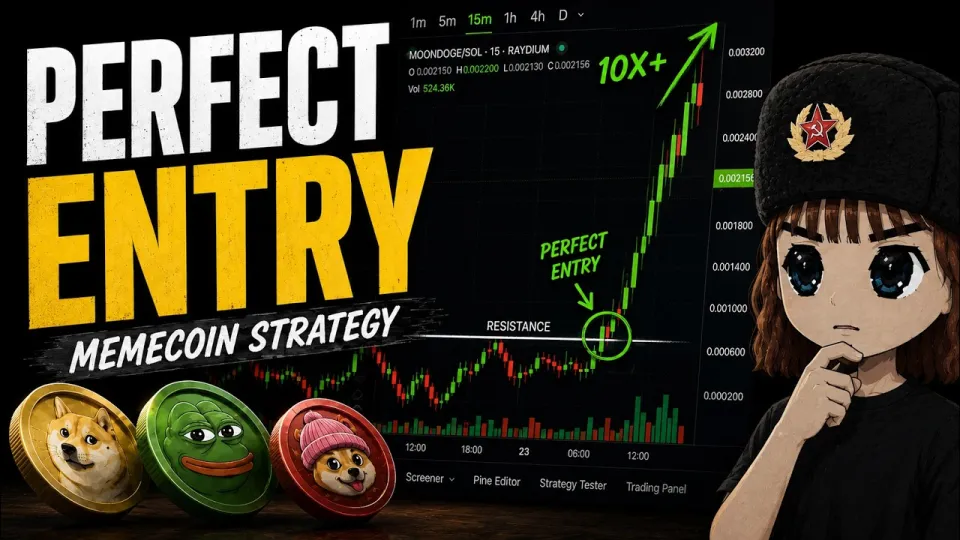
Video: How I Find the PERFECT Entry on Memecoins 📈 (Full Strategy)
You can order the same kind of articles for your own video to boost it on YouTube and Google. Just message the Telegram bot @sat_sit_bot. The bot writes and publishes the articles itself (with your YouTube video embedded) on popular topical websites (no ads). Your first 50 articles are free.
Key takeaways
- Most meme coin losses come from bad timing, not bad coin selection — the entry sets the entire risk-to-reward of the trade.
- A quality setup needs three confirmations: structure (higher lows or a reclaimed level), momentum without exhaustion, and a defined invalidation point.
- Pullbacks into support after an impulse offer better entries than green candles at the top of a vertical move.
- Red flags that cancel an entry: parabolic candle with no consolidation, falling volume on each push, and a chart that already ran 3–5x.
- Risk, exit targets and profit-taking levels are planned before the buy button, not after price moves.
A meme coin is a highly volatile token whose price is driven mostly by attention and liquidity rather than fundamentals, so the entry point matters more than the ticker. The practical answer: wait for structure plus momentum confirmation, buy the pullback into support rather than the vertical candle, and define your invalidation level and exit plan before you click buy. The full breakdown of this process comes from the «starwifpump» channel video on finding high-quality entries, and the tool stack the author points to is collected in the Plasma Telegram for early access and setup help.
Why the entry decides the outcome of a meme coin trade
Most traders in this niche do not lose because they picked a dead token — they lose because they bought the top of a move that was already exhausting. On a token that can double and halve inside an hour, the same coin can be a great trade or a catastrophic one depending purely on where you entered. A late entry compresses your upside and widens your downside at the same time: the stop sits far away, the first resistance is close, and the risk-to-reward flips against you before the trade even starts.
That is why the working rule is simple: the coin is only half of the decision, the chart position is the other half. Before looking at narratives, socials or a new launch, a trader should be able to answer three questions about the chart — where is the last higher low, what happened on the last impulse, and what price proves the setup wrong.
The three confirmations to check before any meme coin buy
A valid entry setup is a combination of structure, momentum and a clear invalidation point; if one of the three is missing, the trade is a guess. The sequence below is the order in which these checks make sense.
- Structure. Look for a series of higher lows on the lower timeframes, or a level that price broke and then successfully retested as support. A chart making lower highs into a downtrend is not a setup, no matter how cheap the token looks.
- Momentum without exhaustion. Volume should expand on the impulse and stay healthy during consolidation. Momentum is confirmed when the token holds its gains instead of giving the whole candle back within minutes.
- Invalidation. Mark the price that would prove the idea wrong — usually just below the higher low or the reclaimed level. If that level is too far from your entry to size the position properly, the entry is bad regardless of how good the story is.
How to enter on a pullback instead of chasing the pump
Chasing a green candle is the most common way to turn a good coin into a bad trade, and the alternative is to let the impulse finish and buy the retrace. After a strong move, price usually pulls back toward the breakout level, the moving average, or the previous consolidation range — those are the zones where risk is smallest and the stop is closest.
The practical process looks like this: wait for the impulse, mark the support zone it left behind, then wait for price to come back into that zone and show a reaction — a wick, a reclaim, a higher low on a short timeframe. Entering there gives you a tight invalidation level and a much better risk-to-reward than buying the third consecutive green candle at the highs. If the pullback never comes and the token keeps running without you, that is a missed trade, not a loss — and missed trades cost nothing.
Red flags that tell you not to enter
Knowing when to skip a trade is as valuable as knowing when to take one, because the setups you avoid protect the capital that funds the good entries. The signals below consistently precede bad fills.
- A vertical, parabolic candle with no consolidation underneath — there is no reference level for a stop.
- Volume shrinking on each successive push higher, which means the buying is thinning out.
- A token that has already run several multiples from its launch or base, where most of the move is behind it.
- A chart that gives back an entire impulse candle within minutes, showing sellers absorbing the buyers.
- A setup where the only reason to buy is that others are buying — pure FOMO with no level to lean on.
Patience is the actual edge here. Sitting out a bad chart is a decision, and it is usually the more profitable one.
Planning risk, exits and profit-taking before the buy
The trade plan is written before the entry, not improvised after price moves, because decisions made in a live candle are emotional decisions. Before buying, define the position size so that hitting the invalidation level costs an amount you can accept without changing your process, and set the first profit target near the obvious resistance or the previous high.
A common structure is to take part of the position off at the first target, move the stop toward breakeven, and let the rest run with a trailing level. The exact percentages are a personal choice, but the order is not: risk first, targets second, entry last. If the risk-to-reward is not clearly favorable at the price you are about to pay, the correct action is to wait for a better price or skip the token entirely.
Common questions from newer meme coin traders
Beginners tend to ask the same things, and the answers usually come down to process rather than secrets. Questions about which trackers or filters to use, how to catch a token before a social post pumps it, and whether the same rules apply across chains all point to the same principle: the tools change, the chart logic does not.
A few practical notes. Different chains — Solana, Ethereum, Base, newer ecosystems — have different liquidity depth and speed, so the same pattern behaves more violently on thin liquidity; adjust size accordingly. Social trackers can surface attention early, but attention without a chart structure is not an entry. And if a trader has already lost money in this market, the fix is not a bigger position but a smaller one with a written plan, because the strategy only works when the risk per trade is survivable.
Useful links
- Plasma Telegram — early access, updates and setup help
- Discord community
- Padre terminal VIP access
- Solpump
- starwifpump on X
Bottom line
A repeatable meme coin process beats prediction every time: check structure, confirm momentum, buy the pullback, and know your invalidation before you enter. The goal is not to catch every move but to make each trade a calculated one with a defined risk and a planned exit. The «starwifpump» channel builds its full entry strategy around exactly this logic, and the Plasma Telegram is where the author shares early access and setup help for the tools used in the breakdown. Treat meme coins as high-risk instruments, size positions accordingly, and let patience do the work that FOMO cannot.
Source: How I Find the PERFECT Entry on Memecoins 📈 (Full Strategy) · Markdown version
Questions & answers
How do I know a meme coin entry is good enough to take?
A good entry has three things at once: a clear structural level to lean on, momentum that is holding rather than exhausting, and an invalidation point close enough that the position can be sized sensibly. If any of those is missing, the setup is a guess rather than a trade. Waiting for a pullback into support usually produces this combination better than buying a vertical candle.
Should I buy a meme coin while it is pumping?
Usually not at the top of the impulse. Buying during a vertical move leaves no reference level for a stop and compresses the upside, because the first resistance is close while your risk is far away. The alternative is to let the move finish, mark the support it left behind, and enter on the retest if price reacts there.
Do the same entry rules apply on every chain?
The chart logic — structure, momentum, pullbacks, invalidation — transfers across chains, but liquidity depth changes how violently a pattern plays out. Thin liquidity on a new ecosystem can produce faster wicks and deeper retraces, so position size should be smaller than on a deep, liquid market. The pattern is the same; the risk calibration is not.
What should I do if I already lost money trading meme coins?
The answer is not a bigger position to win it back, but a smaller one with a written plan: defined invalidation, defined first target, and a maximum loss per trade you can survive repeatedly. Trading only becomes a process when a single bad outcome cannot end it. If the losses were large relative to capital, sitting out until a clear setup appears is a legitimate decision.